Granny was a Communist

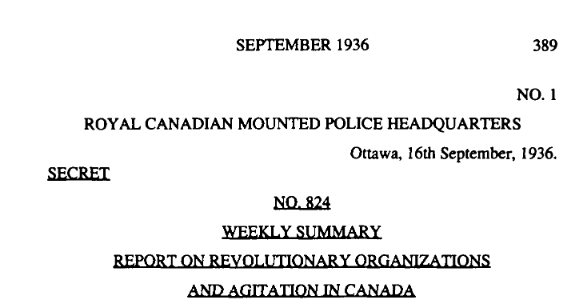
Researching family history is seldom dull. Sometimes though a surprise comes out of nowhere. This week it came from a cousin on my father's side that I hadn't talked to in decades. She emailed me a copy of a 1936 SECRET RCMP Report on Revolutionary Organizations and Agitation in Canada.
Down on page 394, there it was, "Mrs. Otto Rueger".
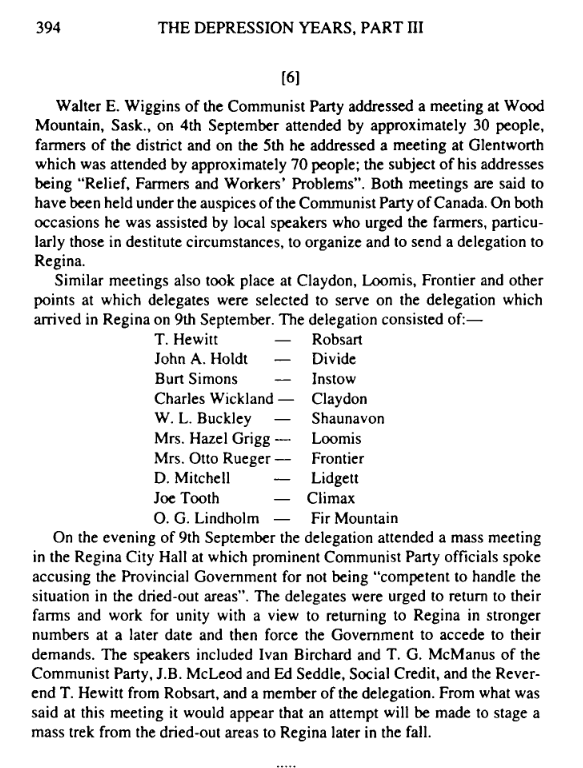
(This was after sections concerned with fur workers, and those darned Ukrainians. You can grab the whole report here.)
Obviously there's a whole lot of FOI work coming up. This is not something I ever imagined anyone in my family, much less my Grandparents, doing.
After a quick bit of research I know that at the time, during the Depression and dustbowl era, the Communists were actually pretty widespread in Western Canada, right through to British Columbia. I have to assume that they led pretty directly to the Co-operative Commonwealth Federation (CCF), who eventually became the New Democratic Party, the formerly labour and left-wing Canadian political party.

A final quirk in this whole story. Both sets of my grandparents were homesteaders in Saskatchewan. Basically during the early 20th century, if you were deemed to be of the right stock (English, Scottish, Ukrainian especially) the government would grant you a chunk of "virgin" land (aka, stolen from the Indigenous people who previously lived there) where you would build a sod hut and start a farm.
It turned out to be a terribly harsh life. Out of that poverty and suffering you saw people like Lydia Rueger marching on the provincial capital to demand support for suffering farmers. That led to the CCF, and Tommy Douglas, who brought in crazy socialist ideas like Medicare, and money for poor people. And, of course, Mouseland.
According to family history on my mother's side, it was those crazy socialist ideas that convinced her father, WW1 veteran Earl Anger, to leave Saskatchewan and move to Alberta. Which is, eventually, how I came to be born in Calgary.
Mouseland
A Political fable told by Tommy Douglas 1944
It's the story of a place called Mouseland. Mouseland was a place where all the little mice lived and played, were born and died. And they lived much the same as you and I do.
They even had a Parliament. And every four years they had an election. Used to walk to the polls and cast their ballots. Some of them even got a ride to the polls. And got a ride for the next four years afterwards too. Just like you and me. And every time on election day all the little mice used to go to the ballot box and they used to elect a government. A government made up of big, fat, black cats.
Now if you think it strange that mice should elect a government made up of cats, you just look at the history of Canada for last 90 years and maybe you'll see that they weren't any stupider than we are.
Now I'm not saying anything against the cats. They were nice fellows. They conducted their government with dignity. They passed good laws--that is, laws that were good for cats. But the laws that were good for cats weren't very good for mice. One of the laws said that mouseholes had to be big enough so a cat could get his paw in. Another law said that mice could only travel at certain speeds--so that a cat could get his breakfast without too much effort.
All the laws were good laws. For cats. But, oh, they were hard on the mice. And life was getting harder and harder. And when the mice couldn't put up with it any more, they decided something had to be done about it. So they went en masse to the polls. They voted the black cats out. They put in the white cats.
Now the white cats had put up a terrific campaign. They said: "All that Mouseland needs is more vision." They said: "The trouble with Mouseland is those round mouseholes we got. If you put us in we'll establish square mouseholes." And they did. And the square mouseholes were twice as big as the round mouseholes, and now the cat could get both his paws in. And life was tougher than ever.
And when they couldn't take that anymore, they voted the white cats out and put the black ones in again. Then they went back to the white cats. Then to the black cats. They even tried half black cats and half white cats. And they called that coalition. They even got one government made up of cats with spots on them: they were cats that tried to make a noise like a mouse but ate like a cat.
You see, my friends, the trouble wasn't with the colour of the cat. The trouble was that they were cats. And because they were cats, they naturally looked after cats instead of mice.
Presently there came along one little mouse who had an idea. My friends, watch out for the little fellow with an idea. And he said to the other mice, "Look fellows, why do we keep on electing a government made up of cats? Why don't we elect a government made up of mice?" "Oh," they said, "he's a Bolshevik. Lock him up!" So they put him in jail.
But I want to remind you: that you can lock up a mouse or a man but you can't lock up an idea.
The Moral of the Story "Mouseland" is a political fable, originally told by Clare Gillis, a friend of Tommy Douglas. Tommy has used this story many times to show in a humorous way how Canadians fail to recognize that neither the Liberals or Conservatives are truly interested in what matters to ordinary citizens; yet Canadians continue to vote for them.